
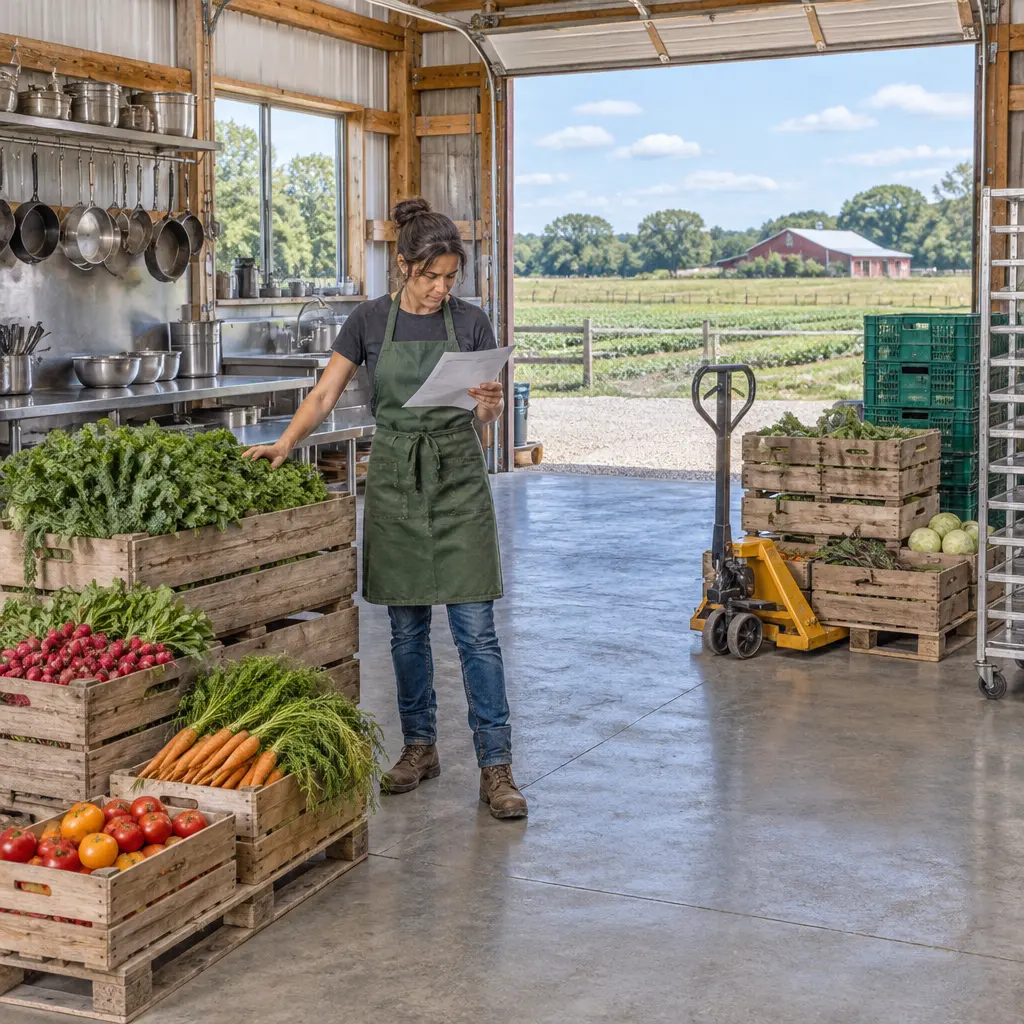
Farm-to-table authenticity is the verifiable connection between a restaurant’s ingredient claims and the farms, fisheries, or other producers that supplied those ingredients. It goes beyond appealing menu language: credible claims can be traced through records, checked against recognized standards, and described precisely enough that diners know what is local, seasonal, or directly sourced. The distinction matters in a food system where the U.S. Department of Agriculture’s 2022 Census of Agriculture counted 1.9 million farms, while the U.S. Food and Drug Administration’s Food Traceability Rule establishes recordkeeping requirements for certain foods across complex supply chains. This guide explains how provenance verification works, which evidence is useful, how claims such as “local” and “organic” differ, and what restaurants and diners can do to separate documented sourcing from marketing.
Provenance Verification Defines Farm-to-Table Authenticity
Ingredient provenance is the documented history of where a food originated and how it moved through the supply chain. The Institute of Food Technologists describes food traceability as the ability to follow food through specified stages of production, processing, and distribution. Applied to restaurant sourcing, provenance verification means linking a menu statement to reliable evidence—such as supplier invoices, farm records, lot identifiers, delivery documents, or certification records—rather than relying on an uncheckable assertion.
“Farm-to-table” does not have one universal federal definition for restaurant menus. That makes specificity essential. A restaurant may truthfully buy some items from nearby farms while sourcing other ingredients through wholesalers. Authenticity is therefore best assessed claim by claim: what ingredient is covered, who produced it, where it came from, when it was harvested or caught, and what evidence supports the statement?
Traceability: Linking an Ingredient to Its Source
Traceability is the capacity to connect a food item to its source and to the businesses that handled it. In practice, a restaurant should be able to match an ingredient on a menu to purchasing records and, where feasible, to a farm, fishery, or producer. Useful documentation includes dated invoices, product descriptions, supplier identity, origin statements, delivery records, and lot or batch details.
The FDA’s Food Traceability Rule, issued under the Food Safety Modernization Act, requires additional records for foods on its Food Traceability List as they move through specified critical tracking events. The rule is designed principally to support faster, more effective foodborne-illness investigations; it is not a general certification that a restaurant’s “local” or “farm-to-table” marketing is accurate. Safety traceability and provenance marketing can use overlapping records, but they answer different questions.
Chain of Custody: Preserving the Evidence
Chain of custody is the documented sequence of transfers between producer, processor, distributor, and restaurant. It helps show that the ingredient being served is the one identified in the sourcing claim. A farm name on an invoice is helpful, but stronger verification also checks that the product, quantity, dates, and delivery route are consistent with the claim.
This distinction is particularly important for products that are pooled, processed, or repacked. A restaurant may receive produce through a distributor even when it originated on a nearby farm; that does not automatically invalidate a local-sourcing claim. But the restaurant needs records that connect the distributor’s shipment to the stated producer rather than treating a distributor’s general regional inventory as proof of origin.
Verification Is Not the Same as Certification
Verification is the process of checking a claim against evidence. Certification is a formal assessment against a defined standard, usually conducted by an authorized or independent organization. A restaurant can verify a direct farm purchase through records without holding a farm certification; conversely, a certification logo does not establish every detail of a restaurant’s local or seasonal sourcing.
The U.S. Department of Agriculture’s National Organic Program, for example, regulates use of the USDA Organic seal and requires certification for most operations that produce or handle organic products, subject to specified exemptions. Organic status concerns production and handling practices under that program. It does not, by itself, mean an ingredient was grown nearby, harvested recently, or purchased directly from a farm.
Sourcing Claims Require Distinct Evidence
Once provenance is understood as a record-backed connection, the next step is to distinguish the claims restaurants commonly make. “Local,” “seasonal,” “organic,” “direct from the farm,” and “sustainable” describe different attributes. Treating them as interchangeable can mislead diners, even when a business has legitimate relationships with producers.
“Local” Describes Geography, but Has No Single National Boundary
Local food generally refers to food produced within a geographically limited area, but there is no single, universally applicable federal mileage boundary for every restaurant-menu use of “local.” The USDA’s Agricultural Marketing Service has noted that local and regional food systems are defined in multiple ways, often by distance, state or regional borders, or relationships between producers and consumers.
A credible restaurant should explain its own boundary—for example, a named county, a specified radius, or a defined multistate region—and apply it consistently. Evidence can include producer addresses, harvest locations, invoices, and delivery documentation. The USDA’s 2022 Census of Agriculture reported 1.9 million U.S. farms, illustrating why a clear geographic definition is more useful than an unqualified claim that ingredients are simply “from local farms.”
“Seasonal” Refers to Availability and Harvest Timing
Seasonal sourcing means selecting ingredients in relation to their natural or regional harvest period and actual availability. A seasonal menu may change as crops mature, weather shifts harvest dates, or supplies run out. The claim is strongest when menus and purchasing records align with local harvest calendars and the restaurant updates descriptions when sourcing changes.
Seasonality is not identical to locality. A product may be in season somewhere else and shipped over a long distance, while a locally grown product may be available outside its field season through storage or greenhouse production. Restaurants can avoid ambiguity by naming the producer and origin, and by stating whether a product is fresh, stored, greenhouse-grown, or preserved.
“Organic” Is a Regulated Production Claim
Organic is a defined production and handling claim governed by USDA National Organic Program standards, not a synonym for local, small-scale, or pesticide-free. The USDA Organic seal applies to products meeting program requirements, and certified operations are subject to inspection and recordkeeping. Restaurants should retain supplier documentation that supports organic claims and avoid implying that noncertified ingredients are certified organic.
The distinction protects both diners and producers: an ingredient can be local but not organic, organic but not local, both, or neither. Menu wording should state only the attribute the evidence supports. When a restaurant uses an organic ingredient in a dish but not every component is organic, the description should not imply that the entire dish or menu is certified.
“Direct from the Farm” Describes a Purchasing Relationship
Direct sourcing means a restaurant buys from a producer without a conventional intermediary, although practical arrangements may include a cooperative, food hub, or shared delivery service. The phrase says something about the transaction, not necessarily the distance traveled or the production method. A restaurant can buy directly from a distant farm, or buy locally grown food through a distributor.
To substantiate a direct-sourcing claim, businesses can retain purchase agreements, invoices, delivery logs, and producer contact information. If a food hub aggregates products from several farms, the restaurant should identify the relevant farm when making a farm-specific claim and should not imply that all ingredients from the hub have the same origin.
“Sustainable” Needs a Stated Standard
Sustainable sourcing is a broad claim that may refer to environmental, labor, animal-welfare, or community outcomes. Without a stated standard, it is difficult for diners to know what is being asserted or how it was assessed. A restaurant should identify the specific practice or independent standard behind the claim, such as a recognized seafood program or a documented farming requirement, and avoid presenting a vague adjective as proof.
Seafood illustrates why precision matters. NOAA Fisheries’ guidance encourages consumers to consider species, origin, and harvest method when assessing seafood choices. A menu that names only a fish species may not provide enough information to establish whether it was wild-caught or farm-raised, or where it came from. Supplier records and applicable fishery or aquaculture documentation can make the claim more meaningful.
Documentation and Audits Validate Ingredient Provenance
A defensible provenance program combines routine purchasing records with checks proportionate to the claim’s importance and risk. The goal is not to burden small farms with unnecessary paperwork; it is to create a reliable, retrievable trail that connects what the restaurant says to what it bought and served.
Supplier Records Create the Basic Evidence Trail
Supplier records are the foundation of verification. Restaurants can maintain a simple file for each supplier containing business identity, contact details, products supplied, origin information, certifications where relevant, and current purchasing documents. For each delivery, the record should capture product, quantity, date, supplier, and any available farm, harvest, lot, or catch information.
A practical system may be a spreadsheet or purchasing platform rather than specialized software. What matters is consistency: records should be updated when a supplier changes, retained for a defined period, and readily matched to menus and invoices. The FDA’s traceability framework emphasizes records that can be provided promptly during investigations; restaurants can adopt the same discipline to answer provenance questions efficiently.
Risk-Based Audits Test Whether Claims Match Purchases
An audit compares claims with underlying evidence. A restaurant can periodically select menu items advertised as local or farm-specific, then compare the menu description with invoices, delivery records, and producer information. Additional checks might include confirming the farm’s location, reviewing current certification status through the relevant program, and checking whether volumes purchased are plausible for the quantity served.
Audits should focus first on claims most likely to affect consumer understanding or regulatory compliance, such as organic status, named farm origin, seafood harvest method, or a prominent “all local” statement. If a discrepancy appears, the restaurant should correct the menu, clarify the claim, or suspend it until the evidence is resolved. The Federal Trade Commission’s Guides for the Use of Environmental Marketing Claims also underscore the broader principle that advertising claims should be truthful, substantiated, and not misleading.
Digital Traceability Can Improve Access, but Does Not Replace Evidence
Digital tools—including inventory platforms, QR codes, and shared traceability systems—can make provenance information easier to organize and communicate. A QR code may lead diners to a producer profile or sourcing statement, but the technology itself does not prove the statement is true. The underlying records and reliable data entry remain essential.
The GS1 Global Traceability Standard offers a framework for identifying products, locations, and traceability events across supply chains. Restaurants need not implement a complex global system to benefit from the principles: use consistent identifiers, record transfers, and make the source information retrievable. A concise digital display should also avoid exposing commercially sensitive information or overstating what the records establish.
Farm-to-Table Claims Affect Consumers, Producers, and Food Safety
Verified sourcing is not only a marketing issue. It shapes consumer trust, supports fair relationships with producers, and can help businesses respond to recalls or supply disruptions. Conversely, vague or exaggerated claims can disadvantage farms that invest in careful production and recordkeeping, while leaving diners unable to distinguish evidence from storytelling.
Consumer Trust Depends on Specific, Checkable Statements
A specific statement—such as “carrots from North Ridge Farm in the Hudson Valley, delivered this week”—is more informative than “fresh from local farms.” The stronger statement identifies a producer, a place, and a time frame that can be checked. Restaurants should use cautious wording when a product is sourced through a broker or when the origin varies by delivery.
The Federal Trade Commission’s consumer-protection approach is relevant here: the overall impression of an advertisement matters, not only whether individual words can be defended in isolation. A menu that prominently suggests an entire meal is local may mislead if only one garnish is locally sourced. Clear qualifiers—such as “local mushrooms; other ingredients sourced regionally and nationally”—can set more accurate expectations.
Producer Relationships Benefit from Transparent Purchasing
Transparent sourcing can help restaurants and producers coordinate planting, harvest, volume, and delivery schedules. Agreements that specify quality, expected quantities, substitutions, and payment terms reduce the chance that a restaurant will make a claim the farmer cannot support. These relationships can also make supply limitations visible before a menu is printed.
The USDA’s Local Food Marketing Practices Survey has documented the scale and variety of direct marketing channels, including farmers markets, community-supported agriculture, and direct sales to restaurants and institutions. Such channels can shorten commercial relationships, but a direct sale is not automatically proof of a particular environmental or labor outcome. Each attribute still needs its own evidence.
Traceability Supports Recall Readiness
When a food safety concern arises, records can help identify affected products, suppliers, and service dates. A restaurant that can quickly determine which deliveries included a specific ingredient may be better positioned to isolate inventory and respond to supplier or public-health guidance. This practical benefit is distinct from proving a menu’s local or sustainable claims, but both depend on organized documentation.
The FDA has described traceability as an important tool for identifying the source and movement of foods during outbreak investigations. Its rule applies to covered foods and entities subject to its requirements, with exemptions and compliance provisions. Restaurants should consult current FDA guidance or qualified counsel to determine their obligations rather than assuming every restaurant or ingredient is covered in the same way.
Restaurants and Diners Can Apply a Practical Verification Checklist
A workable authenticity check does not require diners to audit a supply chain themselves. Restaurants should build the evidence into normal purchasing operations, while diners can ask clear questions and look for answers that distinguish origin, production method, and purchasing relationship.
Restaurant Checklist
- Define what “local” means and disclose the geographic boundary.
- Keep invoices and delivery records linked to supplier and product details.
- Record farm, fishery, harvest, lot, or certification information where available and relevant.
- Review menu claims whenever suppliers, origins, or seasonal availability change.
- Distinguish direct purchasing from local origin, organic certification, and sustainability claims.
- Train staff to answer sourcing questions accurately and to say when information is unknown.
- Correct or remove claims when records do not support them.
Diner Questions That Reveal More Than a Slogan
- Which ingredients in this dish are locally sourced, and how do you define local?
- Can you name the farm, fishery, or producer for this ingredient?
- Is the product organic-certified, or is the claim describing another growing practice?
- Was the seafood wild-caught or farm-raised, and where did it come from?
- Does the sourcing information change with the season or supplier availability?
A restaurant that answers with a named source, a clear definition, and an explanation of how sourcing varies is generally offering more useful information than one that relies only on broad terms. Lack of a detailed answer is not conclusive proof of deception—small businesses may have limited systems—but it is a reason to treat expansive claims cautiously.
Conclusion: Authentic Farm-to-Table Claims Rest on Verifiable Provenance
Farm-to-table authenticity is best understood through provenance verification, chain-of-custody records, and evidence matched to the exact claim. Traceability connects ingredients to sources; standards clarify what terms such as “organic” mean; and careful audits help ensure that menu language reflects actual purchasing. Because “local,” “seasonal,” “direct,” and “sustainable” describe different attributes, restaurants should define each claim rather than treating them as interchangeable.
The broader stakes include consumer confidence, fair producer relationships, and more effective food-safety response. Restaurants can begin with consistent invoices, supplier records, a written definition of local, and a regular review of menu descriptions. Diners can ask where an ingredient came from and what evidence supports the answer. The most credible farm-to-table story is not the most elaborate one; it is the one a business can document and explain plainly.
Sources: U.S. Department of Agriculture, 2022 Census of Agriculture, https://www.nass.usda.gov/Publications/AgCensus/2022/; U.S. Food and Drug Administration, Food Traceability Rule, https://www.fda.gov/food/food-safety-modernization-act-fsma/fsma-final-rule-requirements-additional-traceability-records-certain-foods; Institute of Food Technologists, Traceability, https://www.ift.org/news-and-publications/food-technology-magazine/issues/2016/june/columns/food-safety-and-quality-traceability; U.S. Department of Agriculture, Agricultural Marketing Service, Local and Regional Food Systems, https://www.ams.usda.gov/services/local-regional; U.S. Department of Agriculture, National Organic Program, https://www.ams.usda.gov/about-ams/programs-offices/national-organic-program; U.S. Department of Agriculture, Local Food Marketing Practices Survey, https://www.nass.usda.gov/Surveys/Guide_to_NASS_Surveys/Local_Food/; Federal Trade Commission, Guides for the Use of Environmental Marketing Claims, https://www.ftc.gov/legal-library/browse/rules/green-guides; GS1, Global Traceability Standard, https://www.gs1.org/standards/traceability; NOAA Fisheries, Seafood Choices, https://www.fisheries.noaa.gov/insight/seafood-choices